


This is the first in a series of bonus essays that accompany the documentary series Overshoot: Navigating a world beyond 1.5°C
It’s a moment to take stock.
Whenever something doesn’t work out in life, it’s best to take a moment, ask what happened, and reflect on how things could be improved going forward.
That’s a central motivation of our new documentary series, Overshoot: Navigating a world beyond 1.5°C. The world missed one of its key goals for limiting climate change. As we explore in the series, this has vast implications.
So, as global heating progressively exceeds 1.5°C over the coming years, it’s time to take stock of what brought us here.
To help do that, we visited Coalbrookdale, a gorgeous village in the English county of Shropshire.
Why? Because in many ways, Coalbrookdale is ground zero for climate change.
And it all started with a cooking pot.
Coke and capitalism
In the early 1700s, an iron maker called Abraham Darby started using a blast furnace in Coalbrookdale.
It still exists, maintained by the Ironbridge Gorge Museums, whose wonderful staff hosted us on a wet and windy day in early February.
Back when Darby arrived in Coalbrookdale, the furnace had been used for decades, one of many around the country. His was a venerable profession. Iron had been used for thousands of years in Britain, smelted to make things like swords and tools.
Charcoal – a bit like what you use on a barbeque – was the main fuel that powered the furnaces. Charcoal was cheap, but it didn’t burn hot enough to make the kind of iron we use today.
That’s where Darby made his contribution to history. He started using something called coke to power the furnace, instead of charcoal. Think of it like dried-out coal.
This was to prove a world-historic moment. But you might not have known it at the time.
Here’s Nick Booth - who was Director of Collections and Learning at the Ironbridge Gorge Museums when we visited - to explain:
“...he was able to perfect a process of casting cooking pots in a process using Coke. And that’s really important, because everyone needs a cooking pot. And actually, his genius was that he identified the cooking pot as pretty much the only thing that you could use to make Iron using coke that was cost effective, so it was too expensive to do all the other things that you could do with charcoal already, because charcoal was cheaper. Actually, if you’re making cooking pots, you can cast them a lot thinner, which means they work better...”
Soon, everyone wanted one.
But it wasn’t just about pots. In producing iron of this quality, Darby had demonstrated that coke could make iron with lots of different applications. And in doing so, he contributed to a chain reaction of innovation that soon led to other inventions, like steam engines.
“So the boilers for the first engines were being cast here. So that’s a big part of it. Trevithick, when he was looking to make his first locomotive, 83 he came here to Coalbrookdale…”
Steam engines led to railways and bridges and factories, as the Industrial Revolution exploded across the world.
Next came steel and ships and then cars and planes; more chain reactions, cascading through time and space to help create the societies in which we live today.
One of those early iron bridges still sits in the gorge around Coalbrookdale, towering above the river, an enduring symbol of what was unleashed.
And it wasn’t just technological change that was unleashed.
These chain reactions were powered by the burning of fossil fuels.
Ground zero
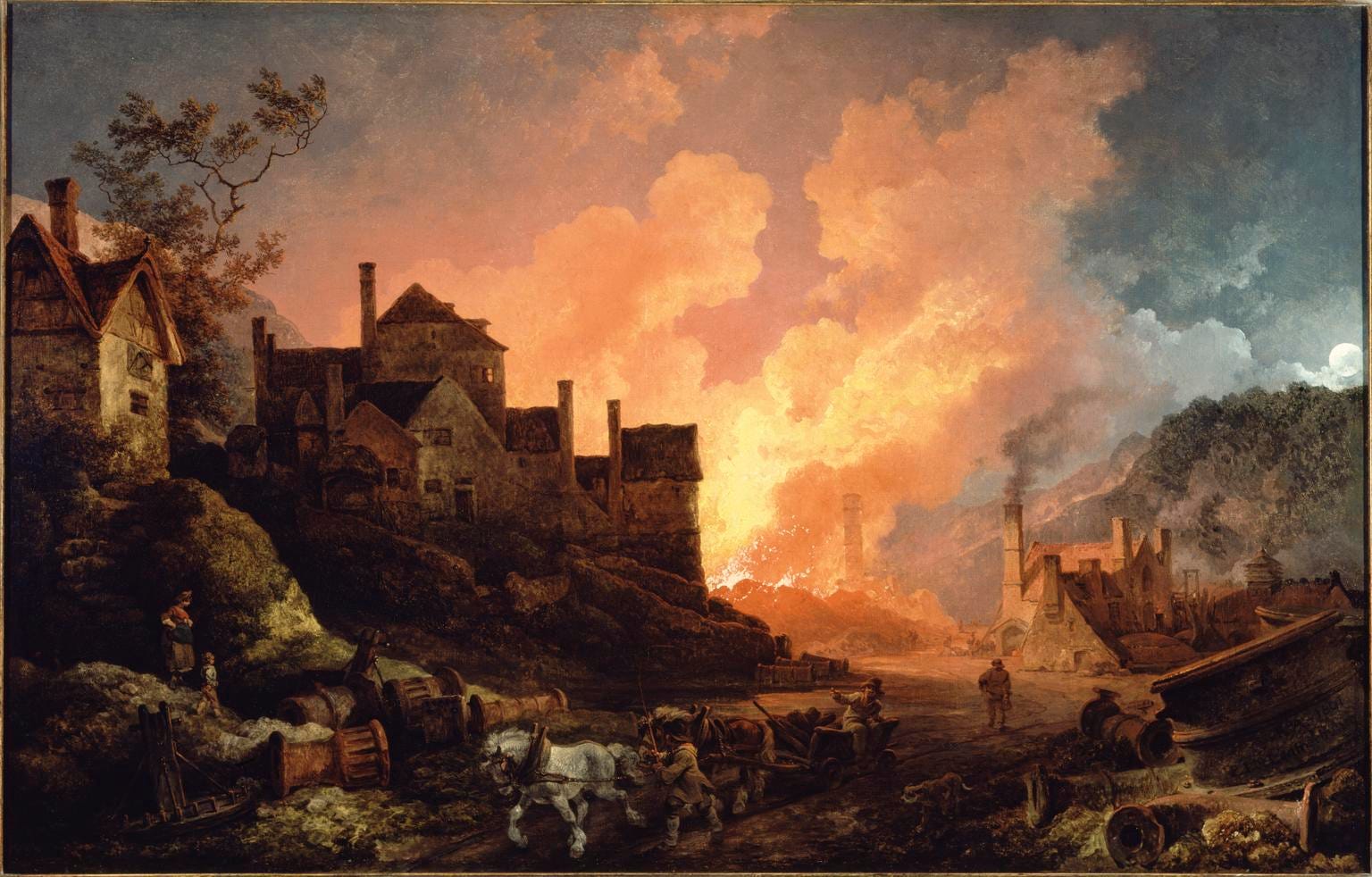
Years ago, I went to a gallery in London to look at a painting called Coalbrookdale at Night by Philip James de Loutherbourg. It was painted nearly a century after Darby’s discovery. You can see it at the top of this post.
It shows the wood furnaces of the Madeley Company, one of the many that sprung up around Coalbrookdale as it became a major global site of industrial production. The cliché that this was ‘the Silicon Valley of its day’ is apt in this case.
I have always found the painting captivating. It glows with the explosive fires of a country passing from the seemingly endless agrarian age to the restless, wrenching change of industrialisation.
How alien it must have seemed at the time. Endless fire at night. Constant, hellish noise. An unnatural irrepressibility, which was soon marshalled by the owners of these machines to discipline workers, setting the terms for the dizzying inequalities of industrial capitalism.
No wonder the furnace’s nickname was ‘bedlam’.
And out from that bedlam in one small corner of England came carbon.
It wafted through the skies along with carbon from more mundane sources - stoves in homes, fires to clear forests - and settled in the atmosphere.
And as industrialisation spread from Coalbrookdale, far more emissions followed.
By the mid-1700s, Britain was pouring more carbon into the atmosphere than all other countries combined - and then some. A lead position it kept for well over a century, as industrialisation spread globally through the reach of capitalism and empire.
This animation from Carbon Brief brilliantly illustrates.
This is why Coalbrookdale is sometimes considered an example of a ‘ground zero’ for climate change. Here’s Nick Booth again:
“…we are a birthplace of industrial revolution. So, you know, we’re a birthplace of the consequences of industrial revolution. So that’s intended, and the positives, like, you know, increased living standards, more materials, that kind of thing. And the unintended and negative, so you could, climate change is absolutely one of those things…”
And that’s one of the main areas in which to take stock today, as the world overshoots 1.5°C of global heating. The processes that led us to this moment go back hundreds of years.
It’s what I had on my mind when we went to see the old blast furnace, the one Darby began using in the early 1700s.
Here’s a picture I took.
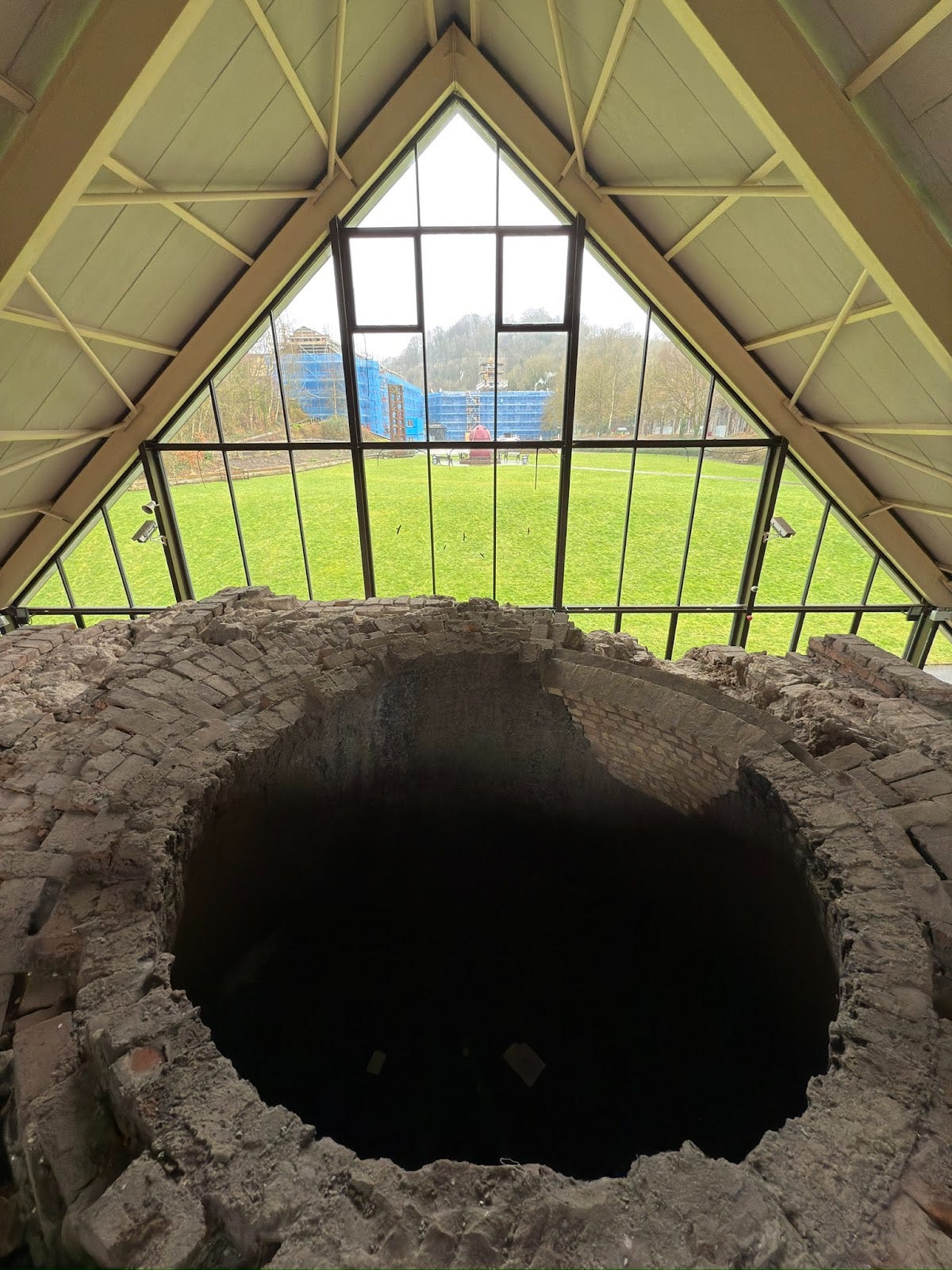
A great maw from which so much poured forth, good and bad. Three centuries later, we are grappling with the legacy of Darby and countless others.
Progress and power
But Coalbrookdale isn’t just a ground zero for climate change. It also played a role in another revolution, one that’s happening right now.
A green industrial revolution.
Because – amazingly – Coalbrookdale is also the birthplace of Thomas Parker, one of the inventors of the very first electric vehicles (EVs), back in the Victorian era.
“He developed for his own use. It was based on a horse cart with his own he built batteries as well. So he built those, and he would drive it to work in the morning. And we’ve got some photos of it. You can see the first one, it’s really you can fit two people on there, and then by his third one, he’s basically got his whole family car. So you can see him. You can you’ve got space for four or six people on there as well.”
Fast forward 130 years and EVs are one of the technologies that can help stop the world filling up the atmosphere with carbon, providing an alternative to vehicles that release carbon from their exhaust pipe.
Together, these technologies are driving something that’s often called the ‘energy transition’.
We also spoke with Jean-Baptiste Fressoz, an historian of science and technology, who explained it to us:
“...when people talk about energy transition, very often they have a history in mind. The idea that in the past we have done energy transition, that during the industrial revolution, Britain shifted from wood to coal, that in the 20th century there was a transition from coal to oil, and I think it is very powerful justification for this idea that facing climate change would just have to do another energy transition, a new energy transition.”
The idea is that, today, there can be a transition from oil and other carbon fuels to clean alternatives.
Something like this is happening all over the world. As we explore in episode 1 of the podcast, the pace of change is astonishing. And Coalbrookedale can help us take stock of that, too.
From the 1920s, a coal power plant in the Ironbridge gorge provided Coalbrookdale with electricity. By the turn of the 20th century, two-thirds of the UK was still powered by coal in an unbroken line going back to the chain reactions set off by Darby and others.
Only 2% of the UK’s electricity was generated by renewables in 1991.
But a few years later and a mix of cheap renewables and government policy meant that the UK didn’t need as much coal anymore.
So much so that, in 2015, the Coalbrookdale power plant was decommissioned.
This video shows it being demolished, the tower tumbling at the head of a valley powered for centuries by coal.
And by October 2024, the whole of the UK stopped using coal entirely for generating electricity. Here’s a news report.
The UK now gets about half of its electricity from renewables.
That this could happen was unimaginable not too long ago: that Britain, the country where the Industrial Revolution began, would become coal-free.
This has led to a drop in the UK’s carbon emissions. It’s also making the UK more energy secure, as the chaos in fossil fuel markets in recent years has exacted a huge cost here and around the world.
But it’s not just the UK. Globally, something similar has been happening.
Between 2014-2024, clean technology costs fell by nearly 80% and investment increased tenfold. Solar generation rose twelvefold and now provides the cheapest electricity in history. In 2024, over 90% of new electricity generation built globally was from renewables.They now make up well over a third of the global electricity supply. The construction of new fossil-powered electricity capacity peaked in 2010.
This is a green chain reaction, one that has started to slow the rate at which carbon enters the atmosphere.
It is one of the most remarkable trends in history, a critical area of progress in the climate fight, one that is only set to accelerate.
More and more
But this trend is set against another.
A huge amount of relative progress has been made, like the story of a coal-free Coalbrookdale. But it’s absolute progress that matters: the cumulative amount of carbon and other ‘greenhouse gases’ in the atmosphere determines the global temperature rise. Like a bucket filling up.
Overall, these emissions are still going up, more each year than the last, as this graph from Our World In Data shows.
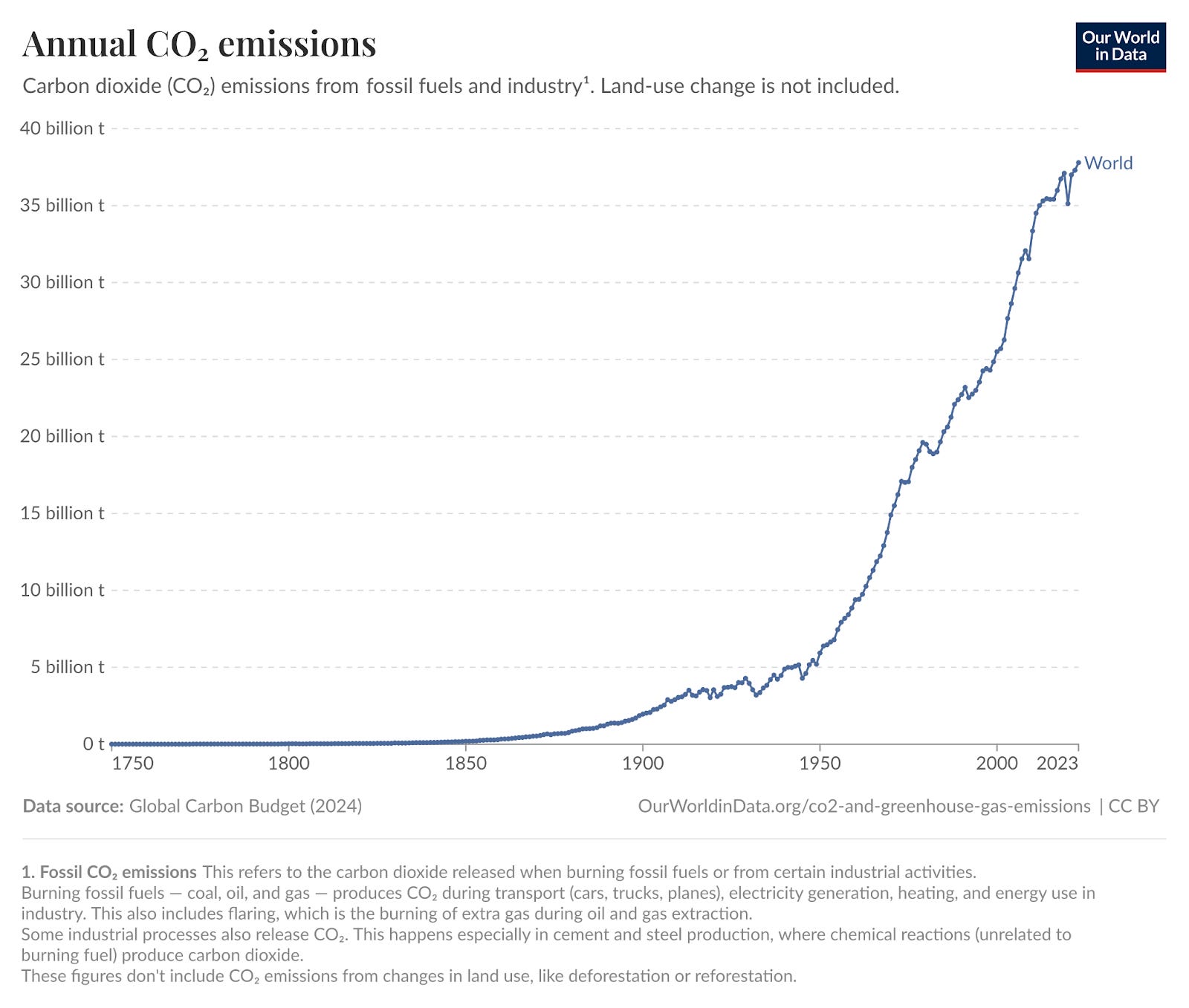
As you can hear in episode one of the series, the flow of emissions is too great to avoid overshooting 1.5°C of global heating.
And as we explore in later episodes, that’s partly because the sheer amount of stuff that is made and used around the world causes so many emissions. The displacement of these by cleaner alternatives - like swapping petrol cars for electric ones - has simply not been fast enough.
This has led some people to say that there hasn’t been so much of an energy ‘transition’, but more like energy ‘additions’, going all the way back to Darby.
Since he used coke instead of wood to make iron, the use of wood has only ever increased alongside coal. Then oil got added to the energy mix. But record amounts of wood and coal have been used alongside it.
Recent changes in coal use show something is changing, like in Britain. Globally, 2025 was the first year that renewables overtook coal as the world’s largest source of electricity.
But it’s not been fast enough.
Here’s Jean-Baptiste Fressoz again:
“So I think we have to remember that despite all the innovations that we had in the 20th century, no raw material became obsolete. There is a very, very big difference between the history of technology and the history of raw materials. And the problem with the environment is that it is raw material consumption that really matters, not so much the technology. So we have to think about the symbiotic expansion of all the energies together and I think this idea of symbiotic expansion does apply to the contemporary situation. Obviously when you replace coal power plants with solar panels or wind turbines you decrease the CO2 emissions. On the other hand what you do with this electricity is crucial. If it is to power 1.7 billion automobiles made out of steel with plastic, glass, copper and all sorts of materials which are carbon intensive, you don’t really make an energy transition. You only decrease the carbon intensity of the economy, which is quite different.”
So this is a critical area in which to take stock, particularly in wealthy countries.
Can we avoid climate catastrophe without a more fundamental rethink of how we make and consume things? Do our climate strategies need to tackle deeper transformations in what society does and is for?
That’s an issue we take stock of in our second episode.
Coming back to haunt us
For now, let’s go back to Coalbrookdale.
Three centuries on from Abraham Darby, buildings by the river in Coalbrookdale now routinely experience floods that were previously considered ‘once in a generation’.
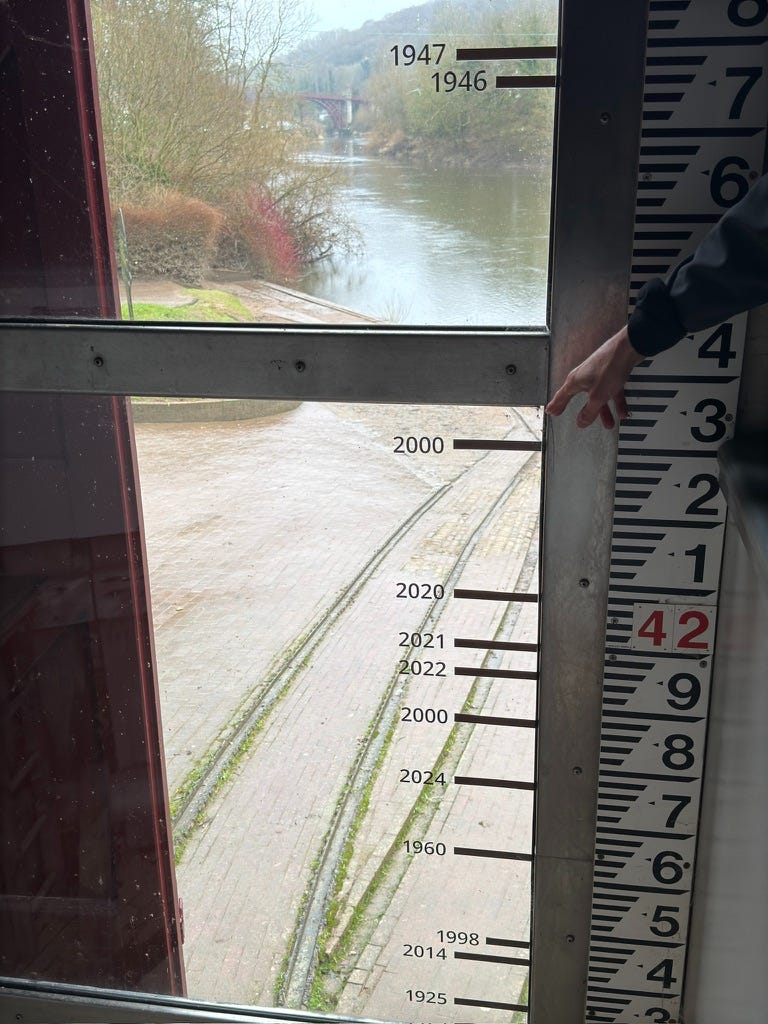
Here’s a picture I took in one of the Ironbridge Gorge Museum’s warehouses. It’s down by the river.
You can see Nick pointing to lines that mark where the flood waters reached. There have been extraordinary floods in the past, including two in the late 1940s.
But look below that, to the cluster of floods in the last few years.
There’s a clear trend, as Nick explained to us:
“...so on the glass, we’ve made an effort to try and record the flood levels at different times during the 20th century. And as I said earlier, there’s a above my head, there’s 1795 then next to me, there’s 1947 1946 two particularly bad years. Then after that, you start to see a bit of a trend coming. So there’s 2000 2000 again, 2020, 2021, 2022, 2024, and this is the this, I think, nicely shows how flooding is becoming a regular and persistent problem in the Iron Bridge gorge.”
It’s one example of a near-infinity of climate impacts spreading out across the world, all of which show that climate change is not a future problem.
It is here, now, and not going away.
These impacts confront us with the failures of the past. That includes the failure to realise a sufficient level of action to prevent the world hitting this fateful milestone of 1.5°C of global heating.
As we set out in episode one, that means a different approach is needed.
Thank you to Sarah, Nick, and all the team at the Ironbridge Gorge Museums. If you’re in the UK, do make time to visit this world-historic site.
Encyclopedic summary of hydrocarbon use, Laurie! Thank you!